The Rosetta Stone is in London, but the world it unlocked is still standing in Egypt
The Rosetta Stone is in London, but the world it unlocked is still standing in Egypt
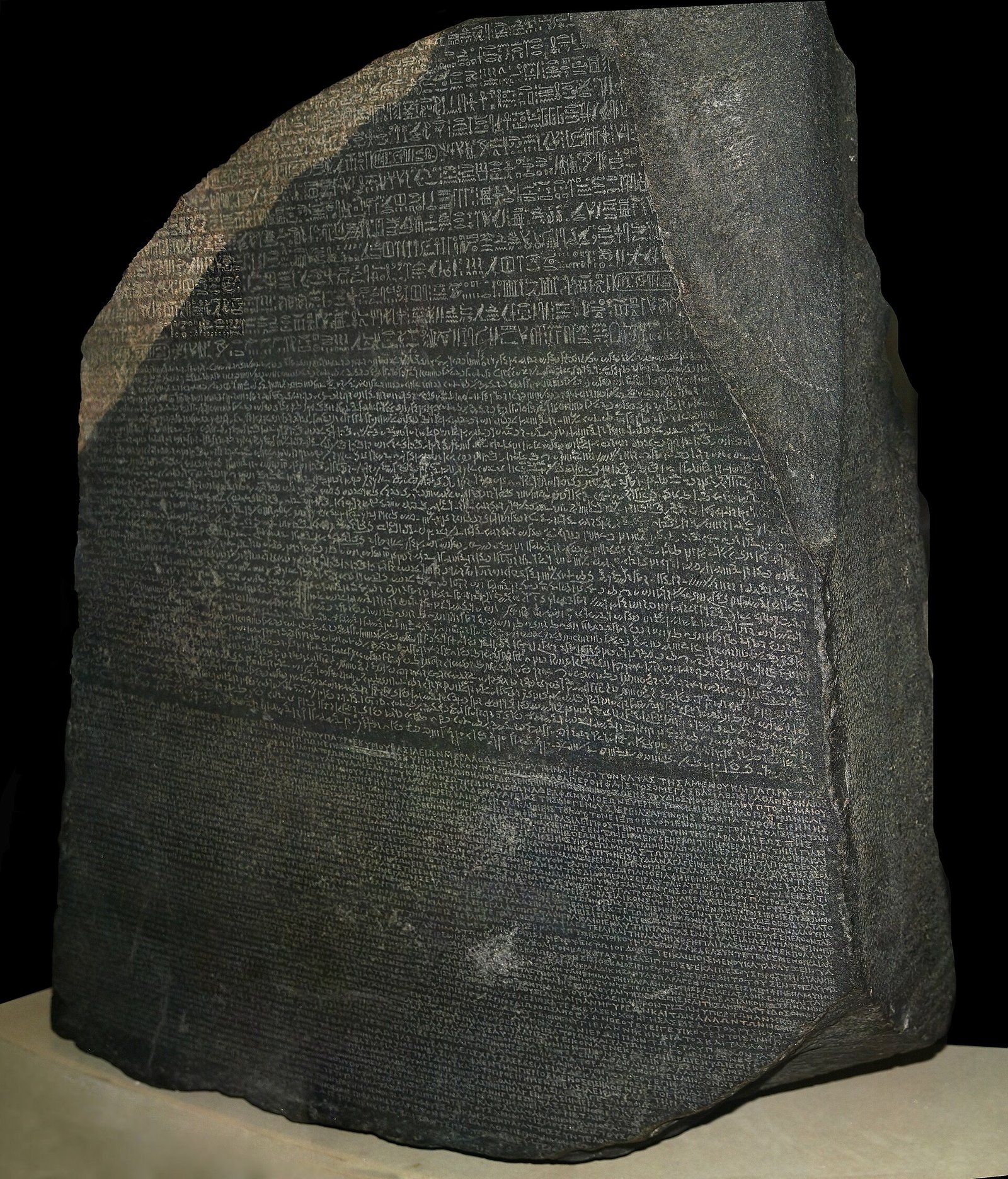
The Rosetta Stone is a broken slab of dark granodiorite carved in 196 BC with one priestly decree written three times: in Egyptian hieroglyphs, in Demotic Egyptian and in ancient Greek. French soldiers found it in July 1799 while rebuilding a fort at Rashid, the Nile delta town Europeans called Rosetta. It passed to Britain in 1801 and has been in the British Museum in London since 1802. Because scholars could read the Greek, it became the key that let Thomas Young and then Jean-Francois Champollion crack hieroglyphs in 1822. You cannot see the original in Egypt, but you can see a replica in Cairo, the fort where it turned up, and the Ptolemaic temples where the same script covers every wall.
What the Rosetta Stone actually is
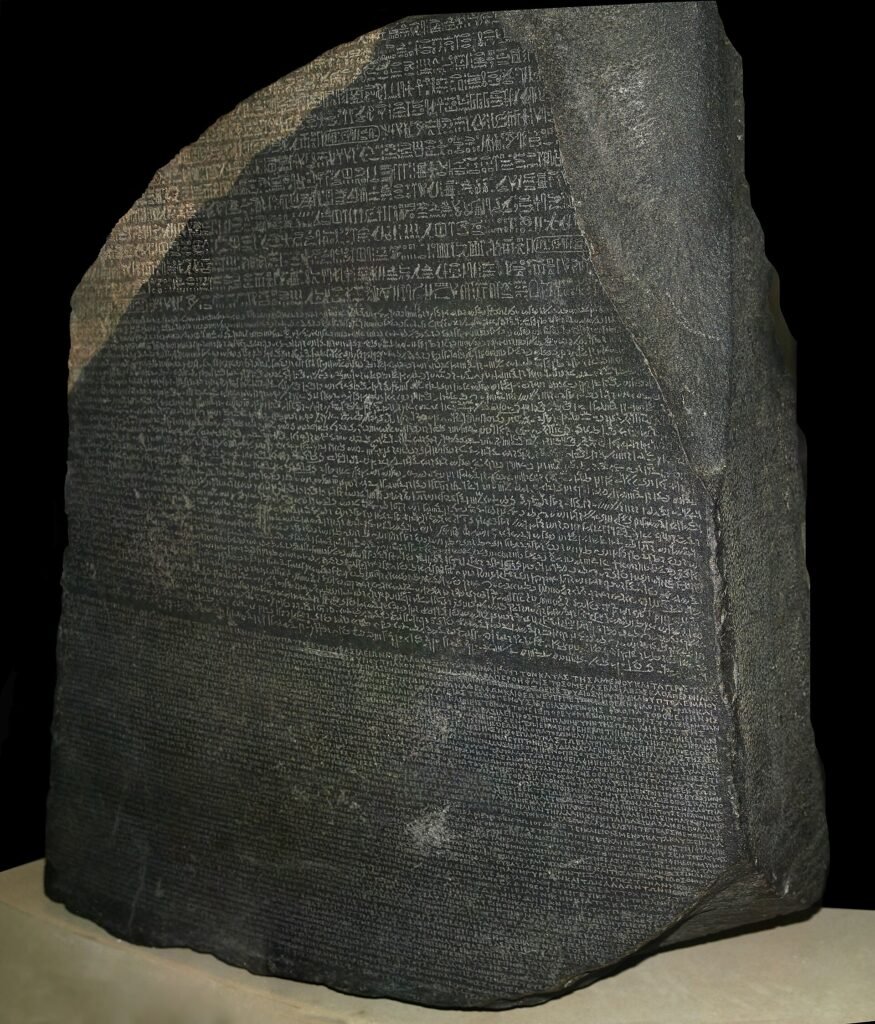
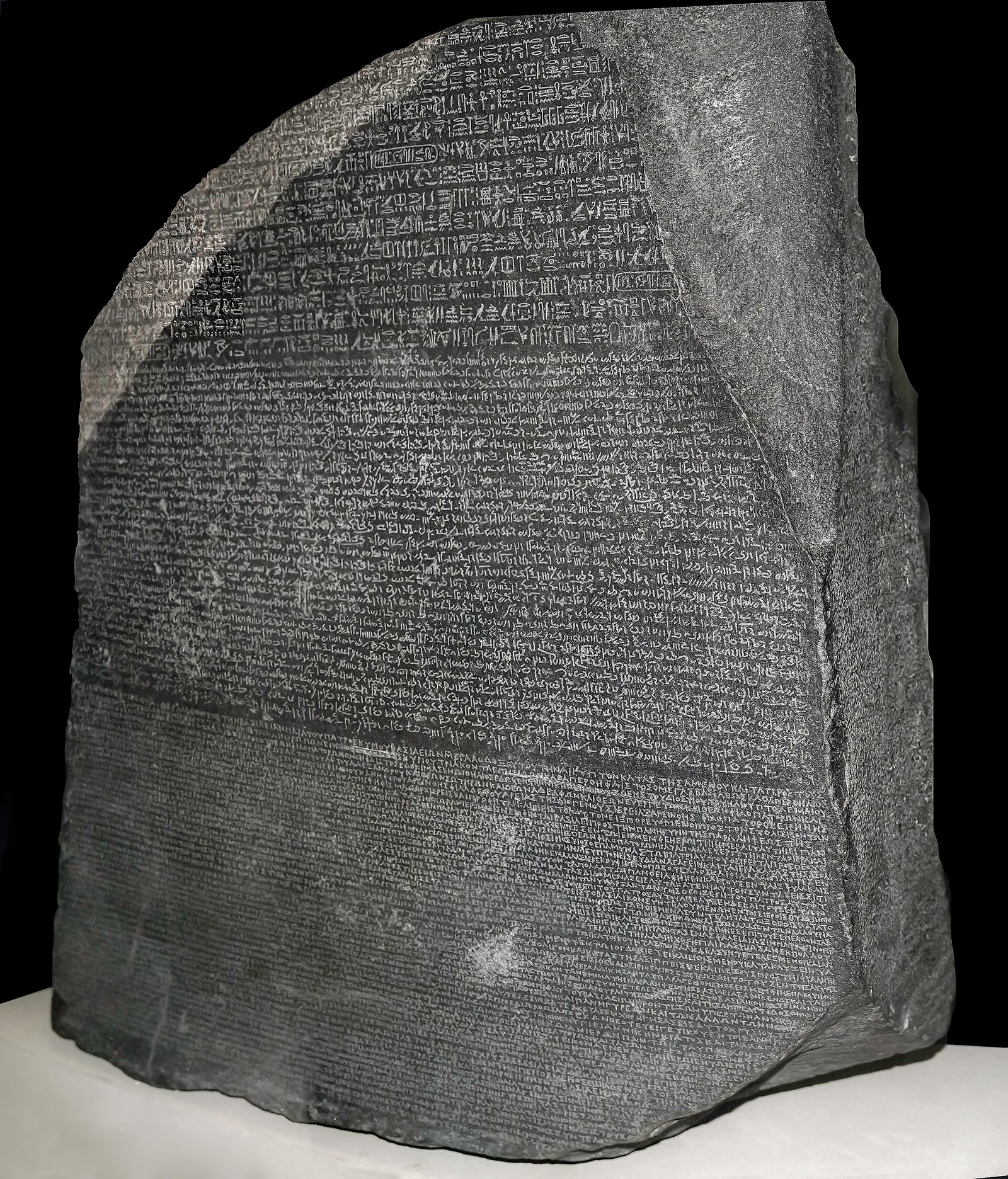
Most people picture it wrong. It is not a tablet, not black basalt, and not complete. It is the lower part of a tall rounded stela cut from granodiorite, a dark gray igneous rock with a pink vein through one corner, about 44 inches tall and three quarters of a ton. The top, which would have shown a winged sun disk and the king before the gods, broke off in antiquity and has never been found.
The face carries three blocks of text. At the top are 14 surviving lines of hieroglyphs, the sacred script of temple walls, with the upper lines lost to the break. In the middle are 32 lines of Demotic, the cursive everyday script Egyptians used for contracts, letters and tax records. At the bottom are 54 lines of ancient Greek, the language of the Ptolemaic court that had ruled Egypt since one of Alexander the Great's generals took the throne.
The three passages say the same thing. That single fact is why a routine administrative notice became one of the most famous objects on earth. Anyone who could read Greek in 1800 held a translation of a hieroglyphic text, and nobody had held one for well over a thousand years.
What the text says: the Memphis decree of 196 BC
The content is almost comically dull for something so important: a decree issued by a council of Egyptian priests at Memphis in 196 BC, the ninth year of the boy king Ptolemy V Epiphanes, confirming his royal cult and thanking him for a list of favors.
Those favors show what a Greek dynasty had to do to keep Egyptian temples on its side. The king had written off tax arrears, reduced certain taxes, released prisoners, ended forced conscription for the navy, made gifts of grain and money to the temples, and put down a rebellion in the delta. In return the priests ordered a statue of the king in every temple, festivals in his honor, and that this very decree be carved on hard stone in the three scripts in use and set up in the temples of the land.
That last clause is the one that matters. The priests wanted the announcement readable by everyone who counted: hieroglyphs for the gods, Demotic for literate Egyptians, Greek for the administration. Bureaucratic thoroughness, not any mystical purpose, produced a trilingual text. And because copies were ordered for many temples, the Rosetta Stone was never unique; it was simply the copy that surfaced first.
The 1799 discovery at Rashid
Napoleon Bonaparte landed in Egypt in the summer of 1798 with an army and a corps of scholars. A year later, in July 1799, French troops were reinforcing a crumbling Mamluk fort on the west bank of the Rosetta branch of the Nile, just north of the town of Rashid, which they had renamed Fort Julien. As they cleared old masonry they pulled out a dark slab covered in carved text, part of it plainly Greek.
The officer in charge, Lieutenant Pierre-Francois Bouchard, understood at once what a multilingual inscription was worth and had it sent to the Institut d'Egypte, the research institute the French had set up in Cairo. Scholars there inked the surface and pressed paper over it to make copies, which reached Paris and circulated across Europe. Long before the stone entered a museum, its text was on the desks of the people who would read it.
Europeans had called Rashid "Rosetta" for centuries, so the slab became the Rosetta Stone. The town still stands where the river meets the Mediterranean, about 40 miles east of Alexandria.
From French hands to British: 1801 and the British Museum
The French expedition did not last. The British navy destroyed the fleet at Aboukir Bay in 1798, and by 1801 a British and Ottoman force had the French army bottled up in Alexandria. When the French surrendered that summer, the Capitulation of Alexandria included an article handing over the antiquities the expedition had collected. The French scholars fought to keep the stone. The British commander insisted, and the slab left Alexandria under British escort.
It arrived in England in 1802 and was presented by King George III to the British Museum, where it has been ever since. Two painted lines on its sides, added in London, still record the episode: one says it was captured in Egypt by the British army in 1801, the other that it was presented by the king.
Young, Champollion and the 1822 decipherment
Reading the stone took two decades and two very different minds, and people still argue over the credit.
Thomas Young's breakthroughs
Thomas Young, the English physicist behind the wave theory of light, took up the stone as a puzzle around 1814. He showed that Demotic was related to the hieroglyphs rather than a separate alphabet, and proved that the oval rings on the hieroglyphic section, the cartouches, enclosed royal names. Matching the Greek "Ptolemaios" against the cartouche, he assigned correct sound values to several signs and published in 1819. His limit was a wrong assumption: only foreign names, he believed, were spelled phonetically; the rest was symbolic.
Champollion's leap
Jean-Francois Champollion, a young Frenchman from Figeac, had an unusual command of Coptic, the last stage of the Egyptian language written in Greek letters and still used in church liturgy. In early 1822 he obtained a copy of an obelisk from Philae, removed to England by William Bankes, whose Greek base named Cleopatra. Comparing the Ptolemy and Cleopatra cartouches, he isolated the shared letters and confirmed a working alphabet.
The decisive moment came in September 1822, when he read a cartouche copied from Abu Simbel: a sun disk, a sign of three fox skins tied together, and folded cloth signs. The sun was "Ra" in Coptic, the cloth he knew as "s" from the Ptolemy cartouche, and the middle sign matched the Coptic word for "born", so the cluster read Ra-mes-es, a name he knew from Greek historians. A native name was spelled with sounds, so the script was a mixed system of sound signs and meaning signs. He announced it to the French academy on September 27, 1822, in his Letter to Monsieur Dacier, and died ten years later at 41.
Why the Rosetta Stone matters more than its text
Before 1822, Egypt could not speak for itself. Everything the modern world believed about the pharaohs came from Greek and Roman writers such as Herodotus, who repeated what their guides told them. Three thousand years of inscriptions on temples, tombs, papyri and coffins sat in plain view and meant nothing.
After Champollion, all of it opened at once. King lists that fixed the chronology. Medical papyri with real prescriptions. Love poems. Court records from a tomb robbery trial. Letters from workmen complaining about late rations. Every excavation since has been read rather than merely dug, which is why "a Rosetta Stone" now means any key that unlocks a closed system.
Our guide to what hieroglyphs mean and how to read them picks up where this page leaves off, if you want the mechanics of the script itself before you travel.
Where the Rosetta Stone is today, and the debate about it
The original is in the British Museum in London, on the ground floor among the Egyptian sculpture, where it is the museum's most visited single object. It sits in a glass case with the three scripts facing the room, and on most days there is a crowd three deep in front of it.
Whether it should stay there is an open question, and we state both positions as they are held. Egyptian archaeologists and cultural figures have called for its return on several occasions, most visibly through public petitions, arguing that it was taken as a spoil of war and belongs to the country whose language it records. The British Museum's position has been that it acquired the stone under a treaty, that an act of Parliament restricts removing objects from its collection, and that millions of visitors see it in London. The conversation continues, and no transfer has taken place.
What is not in dispute is where the other copies live. Fragments of the same Memphis decree have turned up at Elephantine and in the delta, and a near-complete version, the Nubayrah stela found near Damanhur in the 1880s, is in the Egyptian Museum in Cairo, as is the earlier trilingual Canopus decree of 238 BC from Tanis. Egypt holds the family; London holds the famous sibling.
What you can see in Egypt: the replica, Rashid and the related stelae
London has the object. Egypt has the fort it came out of, the museum cases full of its relatives, and every wall the decipherment made readable.
The Egyptian Museum in Tahrir Square
A full-size replica of the Rosetta Stone stands inside the Egyptian Museum in Tahrir Square, near the entrance, and it is the right place to begin. Your guide walks you through the three registers, then takes you to the Ptolemaic material and the Canopus decree, the same practice at work. A reproduction is also shown at the Grand Egyptian Museum in Giza; our Grand Egyptian Museum guide explains how the two museums divide the collection.
Rashid, the town called Rosetta
Rashid is a working delta town on the west bank of the Rosetta branch, a comfortable day trip from Alexandria. The fort the French were rebuilding is the citadel built by the Mamluk sultan Qaitbay in the fifteenth century, restored and open to visitors where the river widens toward the sea. The town is one of the best surviving Ottoman streetscapes in Egypt, all tall brick merchant houses and carved wooden screens. Combine it with the Bibliotheca Alexandrina and you have a coherent day about Egypt's Greek and Mediterranean face.
The Ptolemaic temples where the same hieroglyphs survive
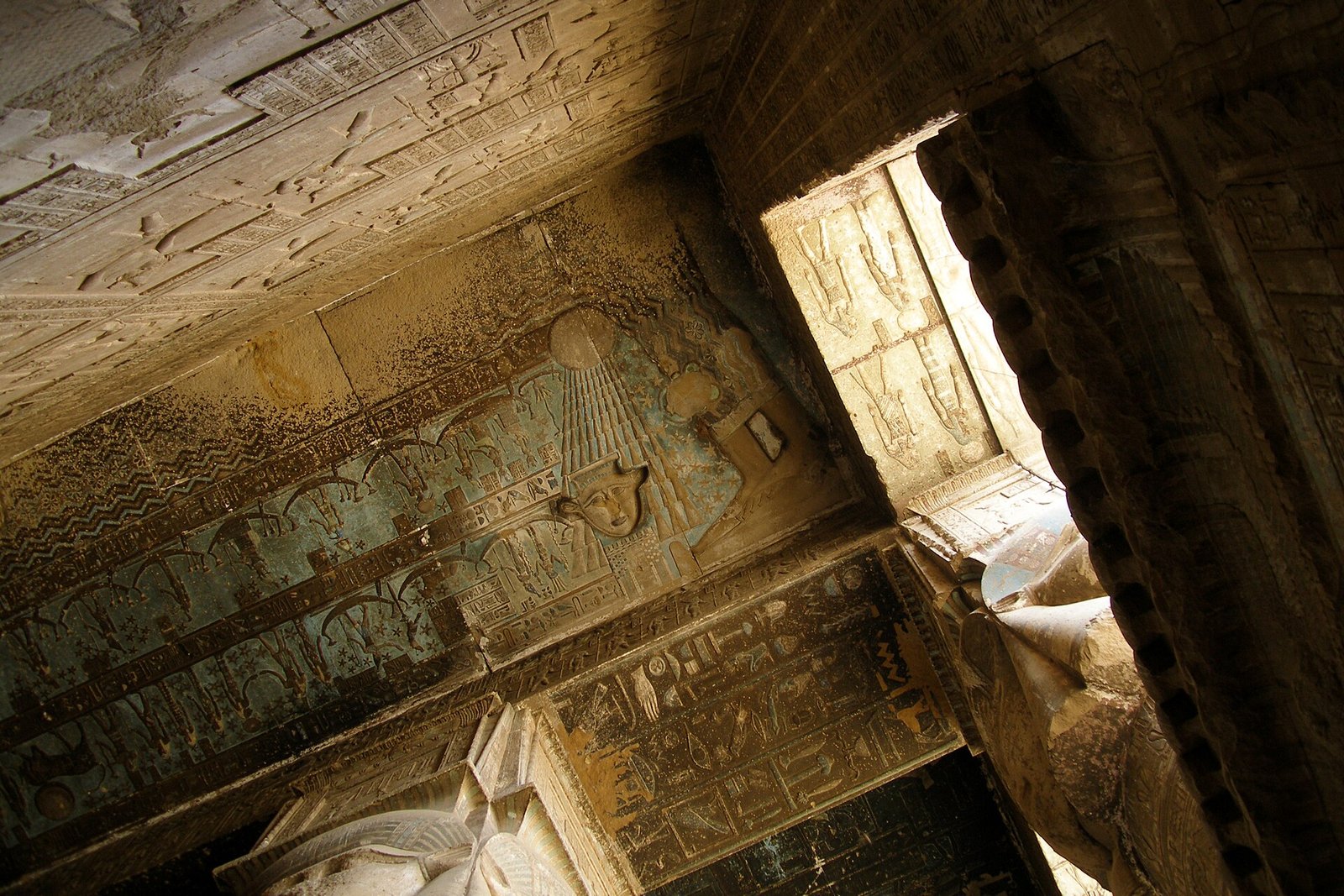
The Rosetta Stone was carved under a Greek dynasty that was also the most prolific temple builder Egypt had seen since Ramesses II. The most complete temples in the country are Ptolemaic, so the hieroglyphs on their walls are exact contemporaries of the stone's top register. Reading them with a guide is the closest you can get to standing inside the decree.
- Edfu. The Temple of Horus at Edfu was begun in 237 BC under Ptolemy III and finished under Ptolemy XII, so its building years bracket the Rosetta decree. It is the best preserved temple in Egypt, roofed and complete, its walls carrying the myth of Horus and the temple's own building history.
- Philae. The island Temple of Isis at Philae is Ptolemaic and Roman, moved to Agilkia island when the High Dam rose. The obelisk whose Cleopatra cartouche helped Champollion came from here, and Philae carries the last dated hieroglyphic inscription anywhere, cut in AD 394.
- Dendera. The Temple of Hathor north of Luxor is late Ptolemaic and Roman, with the rear wall relief of Cleopatra VII and her son Caesarion and ceilings that still hold their color.
- Kom Ombo. A double temple to Sobek and Horus the Elder between Edfu and Aswan, Ptolemaic throughout, with a well-known wall of medical instruments.
Every standard Nile cruise stops at Edfu and Kom Ombo, and most include Philae from Aswan; Dendera is a road day from Luxor. Our guide to the pharaohs as god kings of the Nile explains why a Greek king appears on these walls wearing the double crown, which is exactly the bargain the Memphis decree was sealing.
How a guide reads a cartouche for you
A good Egyptologist guide can teach you to spot a royal name in about ten minutes, and it changes every wall you look at afterward. Roughly, it goes like this.
- Find the oval. A cartouche is a loop of rope with a bar at one end. Anything inside it is a king's or queen's name. Kings usually have two, a birth name and a throne name.
- Work out the direction. Hieroglyphs read toward the faces. If the birds and people inside the loop look left, you start from the left.
- Look for the sun. A plain circle is Ra, and most throne names start with it. In Ramesses, the sun disk is the "Ra" at the front.
- Pick out the alphabet signs. The reed leaf is "i", the water ripple "n", the folded cloth "s", the quail chick "u" or "w", the lion "l". With those five you can already see "Ptolemaios" and "Kleopatra" the way Champollion did.
- Check the ending. A seated woman with an egg after the name marks a queen; that is how the Cleopatra cartouche is confirmed.
- Read the titles outside the loop. The sedge and bee mean "King of Upper and Lower Egypt"; the goose and sun, "Son of Ra".
Once you can do this, the temples stop being decoration. You can find Ptolemy III at Edfu, Cleopatra at Dendera, and Ramesses II among a hundred cartouches at Karnak.
How Explora Egipto builds a hieroglyph-themed day
We are a local agency with our own Egyptologist guides and vehicles, and a theme like this is what we do best, because it turns a checklist of monuments into one story.
In Cairo
Morning at the Egyptian Museum in Tahrir with the replica, the Canopus decree and the Ptolemaic rooms, then the Old Kingdom galleries to see how the script looked two thousand years earlier. Afternoon at Saqqara, where the Pyramid Texts inside the pyramid of Unas are the oldest religious writing on earth.
In Alexandria
A private car east along the coast to Rashid for the Qaitbay fort and the Ottoman houses, then back for the Bibliotheca Alexandrina and the catacombs of Kom el Shoqafa, where Egyptian gods appear in Roman dress. This is the Greek Egypt day, with the stone as its centerpiece even in absence.
On the Nile
Between Luxor and Aswan we brief you on the boat the evening before each temple, so that at Edfu, Kom Ombo and Philae you arrive already able to find the cartouches yourself. Dendera from Luxor is the natural add-on.
All of this fits inside any of our standard tours or a fully custom Egypt tour; tell us how deep you want to go and we shape the days. Ask us for the quote.
Frequently asked questions
Where is the Rosetta Stone right now?
The original is in the British Museum in London, displayed since 1802 after passing from French to British hands under the 1801 Capitulation of Alexandria. It is not in Egypt. In Egypt you can see a full-size replica at the Egyptian Museum in Tahrir Square, a reproduction at the Grand Egyptian Museum, and related Ptolemaic decrees such as the Canopus stone and the Nubayrah stela.
What does the Rosetta Stone actually say?
It is a decree issued by a council of Egyptian priests at Memphis in 196 BC honoring the young king Ptolemy V. It thanks him for writing off tax arrears, releasing prisoners and giving gifts to the temples, orders statues and festivals in his name, and instructs that the decree be carved in hieroglyphs, Demotic and Greek in temples across Egypt. The content is administrative; the value lies in one text in three scripts.
Who deciphered the Rosetta Stone, Young or Champollion?
Both contributed, and Champollion finished it. Thomas Young proved by 1819 that cartouches held royal names and assigned sound values to several signs in "Ptolemy". Jean-Francois Champollion, using the Cleopatra cartouche from a Philae obelisk and his Coptic, showed in September 1822 that the script combined sound signs and meaning signs and that native names like Ramesses were spelled phonetically. His Letter to Monsieur Dacier is treated as the birth of Egyptology.
Why is it called the Rosetta Stone?
Because it was found near Rashid, the town at the mouth of the western branch of the Nile that Europeans had long called Rosetta. French soldiers under Lieutenant Bouchard pulled it out of the walls of a Mamluk fort they were reinforcing in July 1799. The fort, built by Sultan Qaitbay in the fifteenth century, still stands and can be visited on a day trip from Alexandria.
Can I visit the place where the Rosetta Stone was found?
Yes. The Qaitbay fort at Rashid, which the French called Fort Julien, is open to visitors on the riverbank a short drive north of the town, and Rashid itself has a fine set of restored Ottoman brick houses. We run it as a private day from Alexandria, usually combined with the Bibliotheca Alexandrina and the Kom el Shoqafa catacombs. Check current opening days with us before you fix the date.
Where in Egypt can I see hieroglyphs from the same period as the stone?
At the Ptolemaic temples of Upper Egypt. Edfu, begun in 237 BC, is the most complete temple in the country and was under construction when the decree was issued. Philae, Kom Ombo and Dendera are all Ptolemaic and Roman. Every Nile cruise between Luxor and Aswan stops at Edfu and Kom Ombo, Philae is a standard Aswan visit, and Dendera is a road day from Luxor.
See the Egypt the Rosetta Stone taught the world to read
Tell us your dates and how much of the story you want, from a single museum morning in Cairo to a Rashid day and a Nile cruise through the Ptolemaic temples, and we come back with an itinerary and an Egyptologist guide who reads the walls with you. Ask us for the quote.